DOI: 10.12890/2024_004530
Navigating a complex case of Mycobacterium xenopi in a patient with blue rubber bleb nevus syndrome
Authors
 umer_rz@hotmail.com
Keywords
Blue rubber bleb nevus syndrome, Mycobacterium xenopi, bronchiectasisAbstract
Introduction: Blue rubber bleb nevus syndrome is a rare disorder of venous malformations, with around 200 cases reported. We present a case of Mycobacterium xenopi infection in a patient with blue rubber bleb nevus syndrome.
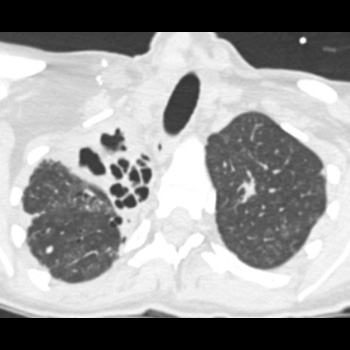
Case Description: A 40-year-old female with blue rubber bleb nevus syndrome, asthma, and bronchiectasis came to the pulmonology clinic with shortness of breath and a cough. She was recently admitted for a bronchiectasis exacerbation but continued to have a worsening productive cough and fevers. The most recent CT scan of the chest showed interval stable right upper lobe fibrocavitary disease, demonstrating gradual progression over two years. She had occasional positive cultures for Mycobacterium Avium Complex and M. xenopi one year previously, assumed to be a colonizer and not treated. Most recent hospital cultures were negative for bacteria and an acid-fast bacilli smear. She was sent to the emergency department for bronchiectasis exacerbation and returned to the clinic six weeks later with two sputum cultures growing M. xenopi. It was decided to treat M. xenopi as this was likely the cause of her cavitary lung lesion and frequent infections. Azithromycin, rifampin, and sulfamethoxazole/trimethoprim were initiated. Intravenous amikacin was added later on. She finally had a right partial lung resection done after one year at an outside hospital. She was on and off antibiotics for M. xenopi for approximately three years with negative repeat cultures for non-tuberculous mycobacteria.
Conclusion: Due to the high mortality of M. xenopi infections (which can be as high as 69%), treatment of at least twelve months is recommended. To our knowledge, this is the first reported case of M. xenopi in a patient with blue rubber bleb nevus syndrome.
References
- Jin XL, Wang ZH, Xiao XB, Huang LS, Zhao XY. Blue rubber bleb nevus syndrome: a case report and literature review. World J Gastroenterol 2014;20:17254–17259.
- Dòmini M, Aquino A, Fakhro A, Tursini S, Marino N, Di Matteo S, et al. Blue rubber bleb nevus syndrome and gastrointestinal haemorrhage: which treatment? Eur J Pediatr Surg 2002;12:129–133.
- Soblet J, Kangas J, Nätynki M, Mendola A, Helaers R, Uebelhoer M, et al. Blue rubber bleb nevus (BRBN) syndrome is caused by somatic TEK (TIE2) mutations. J Invest Dermatol 2017;137:207–216.
- Gilbey LK, Girod CE. Blue rubber bleb nevus syndrome: endobronchial involvement presenting as chronic cough. Chest 2003;124:760–763.
- Soni L, Prasad G. Anaesthetic challenges and management of a child of blue rubber bleb nevus syndrome (BRBNS) with pulmonary lesions. Indian J Anaesth 2023;67:239–240.
- Langleben D, Wolkove N, Srolovitz H, Billick RC, Sheiner NM. Hemothorax and hemopericardium in a patient with Bean’s blue rubber bleb nevus syndrome. Chest 1989;95:1352–1353.
- Bachar K, Shulimzon T, Ofek E, Segel MJ. Pleuritis due to Mycobacterium xenopi without pulmonary infection. Access Microbiol 2022;4:000328.
- Daley CL, Iaccarino JM, Lange C, Cambau E, Wallace RJ Jr, Andrejak C, et al. Treatment of nontuberculous mycobacterial pulmonary disease: an official ATS/ERS/ESCMID/IDSA clinical practice guideline. Clin Infect Dis 2020;71:e1–e36. Erratum in: Clin Infect Dis 2020;71:3023.