DOI: 10.12890/2024_004412
Recurrent intra-stent coronary restenosis in a carrier of non-disease-specific antinuclear antibodies
Authors
 valentina.scheggi@gmail.com
Keywords
Intracoronary in-stent restenosis, coronary vasculitis, autoimmune diseaseAbstract
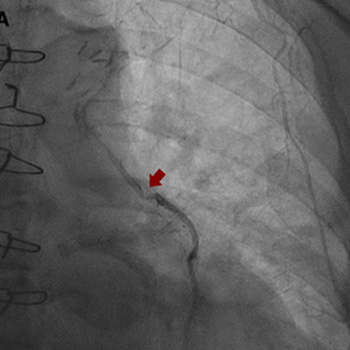
Intracoronary in-stent restenosis (ISR) is a phenomenon that generally occurs between 3 and 6 months after stent placement. With the introduction of drug-eluting stents (DES), the incidence of ISR has decreased but not disappeared. We report a case of reiterant in-stent restenosis of an 81-year-old female patient who underwent multiple percutaneous coronary intervention and two coronary artery bypass surgeries. ISR is possibly associated with extra-stent, stent-related and intra-stent factors. Here, we excluded the first two and focused on the intra-stent factors that seem more likely in our case. A challenging diagnostic workup led us to the hypothesis of a coronary vasculitis potentially triggered by some component of the stent in a predisposed patient carrier of non-disease-specific ANA, with an exaggerated immune response. No recurrence of ISR occurred after the introduction of steroids. Biological and intra-stent causes of ISR should be taken into careful consideration to aim for the early detection of the underlying mechanism of restenosis and to embrace the best therapeutic strategy.
References
- Hu W, Jiang J. Hypersensitivity and in-stent restenosis in coronary stent materials. Front Bioeng Biotechnol 2022;10:1003322.
- Shlofmitz E, Iantorno M, Waksman R. Restenosis of drug-eluting stents: a new classification system based on disease mechanism to guide treatment and state-of-the-art review. Circ Cardiovasc Interv 2019;12: e007023.
- Pepe M, Napoli G, Carulli E, Moscarelli M, Forleo C, Nestola PL, et al. Autoimmune diseases in patients undergoing percutaneous coronary intervention: a risk factor for in-stent restenosis? Atherosclerosis 2021;333:24–31.
- Schur PH. Laboratory testing for the diagnosis, evaluation, and management of systemic lupus erythematosus: still more questions for the next generations: a tribute and thanks and in memory of my mentor: Henry G. Kunkel. Clin Immunol 2016;172:117–121.
- Chioncel V, Andrei CL, Brezeanu R, Sinescu C, Avram A, Tatu AL. Some perspectives on hypersensitivity to coronary stents. Int J Gen Med 2021;14:4327–4336.
- Omeh DJ, Shlofmitz E. Restenosis of stented coronary arteries. 2023 Aug 8. In: StatPearls [Internet]. Treasure Island (FL): StatPearls Publishing; 2024 Jan.
- Bazyani A, Simion P, Anghel L, Statescu C, Tinica G. Multiple in-stent restenosis. a rare cause of resistance to antiproliferative drugs? Maedica (Bucur) 2019;14:38–44.
- Alfonso F, Coughlan JJ, Giacoppo D, Kastrati A, Byrne RA. Management of in-stent restenosis. EuroIntervention 2022;18:e103–e123.
- Buccheri D, Piraino D, Andolina G, Cortese B. Understanding and managing in-stent restenosis: a review of clinical data, from pathogenesis to treatment. J Thorac Dis 2016;8:E1150–E1162.
- Slodownik D, Danenberg C, Merkin D, Swaid F, Moshe S, Ingber A, et al. Coronary stent restenosis and the association with allergy to metal content of 316L stainless steel. Cardiovasc J Afr 2018;29:43–45.
- Dangas GD, Claessen BE, Caixeta A, Sanidas EA, Mintz GS, Mehran R. In-stent restenosis in the drug-eluting stent era. J Am Coll Cardiol 2010;56:1897–1907.
- Khanna S, Garikapati K, Goh DSL, Cho K, Lo P, Bhojaraja MV, et al. Coronary artery vasculitis: a review of current literature. BMC Cardiovasc Disord 2021;21:7.
- Kikuchi S, Okada K, Hibi K, Maejima N, Yabu N, Uchida K, et al. Coronary arteritis: a case series. Eur Heart J Case Rep 2020;4:1–6.
- Yoon S-O, Roux PP. Rapamycin resistance: mTORC1 substrates hold some of the answers. Curr Biol 2013;23:R880–883.
- Koch W, Böttiger C, Mehilli J, von Beckerath N, Neumann FJ, Schömig A, et al. Association of a CD18 gene polymorphism with a reduced risk of restenosis after coronary stenting. Am J Cardiol 2001;88:1120–1124.
- Fitridge R, Thompson M, editors. Mechanisms of vascular disease: a reference book for vascular specialists [Internet]. Adelaide (AU): University of Adelaide Press; 2011.
- Kazemian MR, Solouk A, Tan A, Seifalian AM. Preventing in-stent restenosis using lipoprotein (a), lipid and cholesterol adsorbent materials. Med Hypotheses 2015;85:986–988.