DOI: 10.12890/2024_004373
The response of osmotic demyelination syndrome to plasmapheresis in a patient presenting with catatonia after correction of hyponatraemia in hyperemesis gravidarum
Authors
 sukrisd.ko@go.buu.ac.th
Keywords
Osmotic demyelination syndrome, catatonia, hyponatraemia, hyperemesis gravidarum, plasmapheresisAbstract
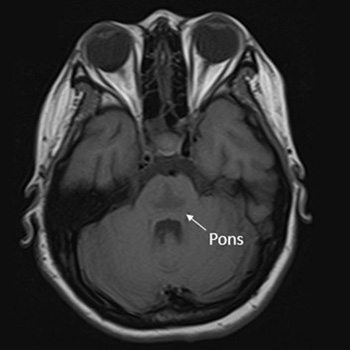
Osmotic demyelination syndrome (ODS) is a disorder characterised by the widespread development of demyelination in both pontine and extrapontine regions. It has been recognised as a complication arising from the rapid correction of hyponatraemia. This study presents the case of a 20-year-old Thai female patient at 10 weeks gestation, exhibiting an initial presentation of catatonia – an uncommon manifestation of ODS. The patient developed symptoms following the rapid correction of hyponatraemia in the context of hyperemesis gravidarum. Magnetic resonance imaging (MRI) of the brain revealed a trident or bat-wing-shaped pattern in T2-weighted and fluid-attenuated inversion recovery (FLAIR) sequences at the central pons. The patient underwent five cycles of plasmapheresis and received rehabilitation, leading to clinical improvement.
References
- Lambeck J, Hieber M, Dreßing A, Niesen W-D. Central pontine myelinosis and osmotic demyelination syndrome. Dtsch Ärztebl Int 2019;116:600–606.
- Adams RD, Victor M, Mancall EL. Central pontine myelinolysis: a hitherto undescribed disease occurring in alcoholic and malnourished patients. AMA Arch Neurol Psychiatry 1959;81:154–172.
- Ambati R, Kho LK, Prentice D, Thompson A. Osmotic demyelination syndrome: novel risk factors and proposed pathophysiology. Intern Med J 2023;53:1154–1162.
- Sánchez-Ferrer ML, Prieto-Sánchez MT, Orozco-Fernández R, Machado-Linde F, Nieto-Diaz A. Central pontine myelinolysis during pregnancy: pathogenesis, diagnosis and management. J Obstet Gynaecol 2017;37:273–279.
- Lohr JW. Osmotic demyelination syndrome following correction of hyponatremia: association with hypokalemia. Am J Med 1994;96:408–413.
- Corona G, Simonetti L, Giuliani C, Sforza A, Peri A. A case of osmotic demyelination syndrome occurred after the correction of severe hyponatraemia in hyperemesis gravidarum. BMC EndocrDisord 2014;14:1–7.
- Sindhu DM, Holla VV, Prasad S, Kamble N, Netravathi M, Yadav R, et al. The spectrum of movement disorders in cases with osmotic demyelination syndrome. Mov Disord Clin Pract 2021;8:875–884.
- Martin RJ. Central pontine and extrapontine myelinolysis: the osmotic demyelination syndromes. J Neurol Neurosurg Psychiatry 2004;75(suppl 3):iii22–28.
- Walther S, Stegmayer K, Wilson JE, Heckers S. Structure and neural mechanisms of catatonia. Lancet Psychiatry 2019;6:610–619.
- Koussa S, Nasnas R. Catatonia and Parkinsonism due to extrapontine myelinolysis following rapid correction of hyponatremia: a case report. J Neurol 2003;250:103–105.
- Louis G, Megarbane B, Lavoué S, Lassalle V, Argaud L, Poussel J-F, et al. Long-term outcome of patients hospitalized in intensive care units with central or extrapontine myelinolysis. Crit Care Med 2012;40:970–972.
- Lim KY, Chia YK, Khoo CS, Tan HJ. Case series of osmotic demyelination syndrome treated with plasmapheresis: experience from two tertiary hospitals. J Clin Neurol 2022;18:117–119.
- Wijayabandara M, Appuhamy S, Weerathunga P, Chang T. Effective treatment of osmotic demyelination syndrome with plasmapheresis: a case report and review of the literature. J Med Case Rep 2021;15:6.
- Kumon S, Usui R, Kuzuhara S, Nitta K, Koike M. The improvement of the outcome of osmotic demyelination syndrome by plasma exchange. Intern Med 2017;56:733–736.
- Fraser D. Central pontine myelinolysis as a result of treatment of hyperemesis gravidarum. Case report. Br J Obstet Gynaecol 1988;95:621–623.
- Janga KC, Khan T, Khorolsky C, Greenberg S, Persaud P. A rare case of central pontine myelinolysis in overcorrection of hyponatremia with total parenteral nutrition in pregnancy. Case Rep Nephrol 2015;2015:940807.
- Anand K, Ranjan Rout R, Subbaiah M, Dorairajan G, Sagili H. Rare complication of hyperemesis gravidarum-central pontine myelinolysis, a case report. J Gynecol 2017;2:000138.
- Ian SM, Zainal N, Hanim A. Neuropsychiatric manifestations of osmotic demyelination syndrome secondary to overcorrection of severe hyponatraemia in hyperemesis gravidarum: a case report. MJP 2018;27:29–34.
- Rodríguez-Pinto F, García-Pardo A, Ardila-Sierra A, Castro CA. Extrapontine myelinolysis in a pregnant with hyperemesis and hyponatremia. A case report. Ginecol Obstet Mex 2020;88:394–401.
- Salim KM, Saidalavi R, Fabin K, Faris KS, Vijayan A. A case report of pregnant lady with hyperemesis gravidarum that led to osmotic demyelinolysis. EJMCR 2021;5:191–196.