DOI: 10.12890/2024_004343
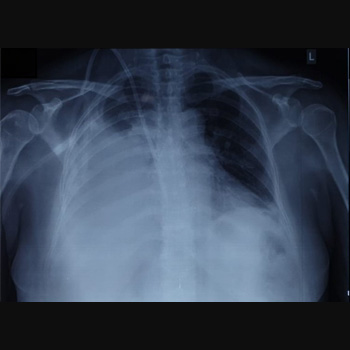
Bilateral pleural effusion in continuous ambulatory peritoneal dialysis managed by VATS pleurodesis
Authors
 jonny_army@yahoo.com
Keywords
Pleural effusion, Pleuroperitoneal leak, Peritoneal dialysis, Pleurodesis, Surgical adhesiveAbstract
Pleuroperitoneal leak as a cause of pleural effusions in peritoneal dialysis is a rare but important complication to consider in continuous ambulatory peritoneal dialysis (CAPD) patients presenting with recurrent progressive dyspnoea. Generally, these effusions are unilateral and right-sided, resulting in shortness of breath and reduced ultrafiltration volume, which are initially managed by peritoneal rest. We describe a case of bilateral pleural effusions in a 57-year-old female on chronic CAPD who developed recurrent progressive dyspnoea but maintained adequate dialysis output. A chest radiograph revealed bilateral pleural effusions with high glucose content, and scintigraphy confirmed the existence of a definite pleuroperitoneal communication. She was managed by temporary substitution to haemodialysis, followed by suturing of the shunt and successful video-assisted thoracoscopic surgery (VATS) pleurodesis with an aldehyde-based surgical glue. Unexplained recurring dyspnoea in chronic CAPD should raise the suspicion of a possible pleuroperitoneal leak, even in patients without an apparent loss of ultrafiltration. Pleurodesis using an aldehyde-based adhesive was effective and tolerated well by our patient and may be considered in managing cases of recurrent pleural effusion.
References
- Chow KM, Szeto CC, Li PK-T. Management options for hydrothorax complicating peritoneal dialysis. Semin Dial 2003;16:389–394.
- Lew SQ. Hydrothorax: pleural effusion associated with peritoneal dialysis. Perit Dial Int 2010;30:13–18.
- Nomoto Y, Suga T, Nakajima K, Sakai H, Osawa G, Ota K, et al. Acute hydrothorax in continuous ambulatory peritoneal dialysis – a collaborative study of 161 centers. Am J Nephrol 1989;9:363–367.
- Chow KM, Szeto CC, Wong TY-H, Li PK-T. Hydrothorax complicating peritoneal dialysis: diagnostic value of glucose concentration in pleural fluid aspirate. Perit Dial Int 2002;22:525–528.
- Bohra N, Sullivan A, Chaudhary H, Demko T. The use of pleural fluid to serum glucose ratio in establishing the diagnosis of a not so sweet PD-related hydrothorax: case report and literature review. Case Rep Nephrol 2020;2020:8811288.
- Harry L, Nyakale N, Tinarwo P. Scintigraphic peritoneography in the diagnosis of pleuroperitoneal leak complicating peritoneal dialysis. Medicine (Baltimore). 2020;99:e21029.
- Chen H-YM, Chan H-YH, Chan H-MH, Cheung H-L. Surgical management of pleuro-peritoneal fistula in chronic renal failure – patient-safety and effectiveness. J Thorac Dis 2021;13:2979–2985.
- Potaris K, Mihos P, Gakidis I. Preliminary results with the use of an albumin-glutaraldehyde tissue adhesive in lung surgery. Med Sci Monit 2003;9:179–183.
- Tsilimigras DI, Antonopoulou A, Ntanasis-Stathopoulos I, Patrini D, Papagiannopoulos K, Lawrence D, et al. The role of BioGlue in thoracic surgery: a systematic review. J Thorac Dis 2017;9:568–576.
- Spotnitz W. Fibrin sealant: the only approved hemostat, sealant, and adhesive – a laboratory and clinical perspective ISRN Surg. 2014;2014:203943.
- Belcher E, Dusmet M, Jordan S, Ladas G, Lim E, Goldstraw P. A prospective, randomized trial comparing BioGlue and Vivostat for the control of alveolar air leak. J Thorac Cardiovasc Surg2010;140:32–38.