Plant-induced hand dermatitis following simultaneous citrus and laurel exposure
Department of Internal Medicine, Unidade Local de Saúde Gaia e Espinho, Vila Nova de Gaia, Portugal
Corresponding author’s e-mail: catarina_a_salvado@hotmail.com
Received: 23/09/2026
Accepted: 05/10/2026
Published: 23/11/2026
Conflicts of Interests: The Authors declare no conflict of interest.
Patient Consent: Written informed consent for publication was obtained from the patient.
This article is licensed under a CC Attribution-NonCommercial-NoDerivatives 4.0 License
How to cite this article: Salvado CA, Guedes AP, Reis AS, Carmo F. Plant-induced hand dermatitis following simultaneous citrus and laurel exposure. EJCRIM 2026;13:doi:10.12890/2026_007552
ABSTRACT
Introduction: Plant-induced hand dermatitis encompasses allergic contact dermatitis, irritant contact dermatitis and phytophotodermatitis. Citrus fruits may cause phototoxic reactions through furocoumarins, whereas Laurus nobilis is a less common cause of allergic contact dermatitis.
Case description: A man presented with a three-day history of painful and pruritic bilateral hand eruption after handling lemons and picking laurel leaves. Lemon exposure occurred on day 1, followed by sunlight exposure on the same day and the following day. Cutaneous lesions developed three days after initial exposure and progressively worsened thereafter. Examination revealed confluent erythematous lesions with blistering involving the fingers and distal dorsum of both hands. Several bullae contained clear serous fluid. Based on the clinical presentation and exposure history, plant-induced hand dermatitis was diagnosed, with phytophotodermatitis considered the most likely mechanism. The bullae were deroofed and drained under aseptic conditions, and the patient was discharged with an oral antihistamine and skincare advice. After one week, the lesions had resolved, leaving post-inflammatory hyperpigmentation.
Discussion: The combination of citrus exposure, sunlight exposure on the day of contact and the following day, delayed onset, blistering and subsequent hyperpigmentation was most consistent with phytophotodermatitis caused by citrus furocoumarins. However, concomitant exposure to laurel represents an additional potential cause of allergic contact dermatitis and illustrates the diagnostic challenge posed by simultaneous exposure to different plant-derived agents.
Conclusion: A detailed exposure history, including the timing of plant contact and ultraviolet (UV) exposure, is essential when evaluating acute blistering dermatitis of the hands.
KEYWORDS
Phytophotodermatitis, contact dermatitis, hand dermatitis, furocoumarins, Laurus nobilis
LEARNING POINTS
- Phytophotodermatitis should be considered in patients presenting with acute blistering dermatitis after exposure to psoralen-containing plants and ultraviolet radiation.
- The chronology of plant contact, ultraviolet (UV) exposure and symptom onset is an important diagnostic clue.
- When patients are simultaneously exposed to different plants, allergic or irritant contact dermatitis should also be considered, even when the clinical presentation favours a phototoxic reaction.
INTRODUCTION
Plant-induced hand dermatitis includes allergic contact dermatitis (ACD), irritant contact dermatitis and phytophotodermatitis[1]. Citrus fruits, such as lemon, contain furocoumarins in their peel that, when activated by ultraviolet (UV) light, produce a phototoxic reaction characterised by erythema and blistering followed by residual hyperpigmentation[2,3]. Lemon rind may also cause true ACD[4]. Laurel leaf and oil contain sesquiterpene lactones and are a rare trigger of ACD[5]. The authors describe a case in which both exposures coincided, highlighting the importance of exposure chronology when distinguishing between different mechanisms of plant-induced dermatitis.
CASE DESCRIPTION
A man presented to the emergency department with a three-day history of progressively worsening, painful and pruritic eruption involving both hands.
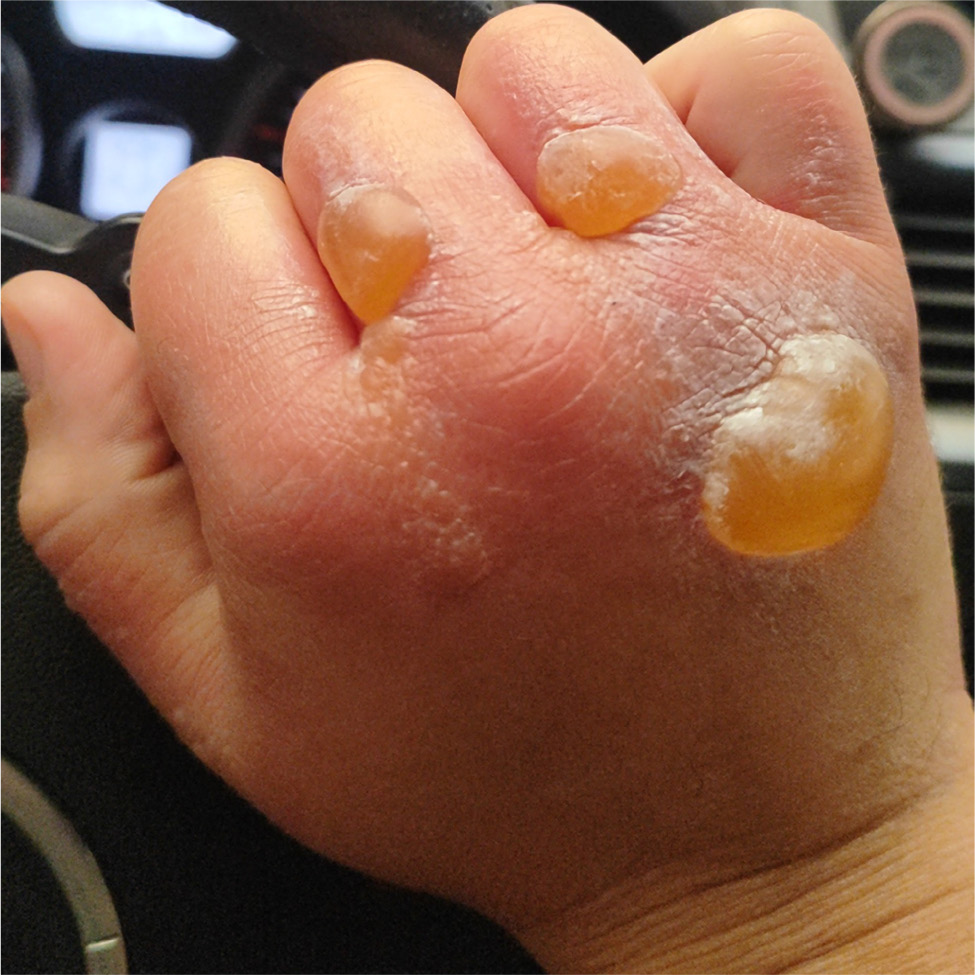
The patient had been handling lemons and picking laurel leaves. He was exposed to sunlight on the same day and again on the following day. Cutaneous lesions developed three days after the initial plant exposure and progressively worsened over the subsequent days. Examination revealed confluent erythematous lesions over the fingers and the distal third of the dorsum of both hands, with blistering; several bullae contained clear serous fluid (Fig. 1). There were no mucosal lesions, fever or systemic symptoms.
A clinical diagnosis of plant-induced hand dermatitis was made. Given the distribution, blistering, exposure history and temporal relationship between citrus contact and sunlight exposure, phytophotodermatitis was considered the most likely mechanism. However, concomitant irritant or ACD related to the plant exposures could not be completely excluded.
(click to enlarge)
Figure 1. Confluent erythema and serous-fluid-filled bullae of the fingers and distal dorsal hands.
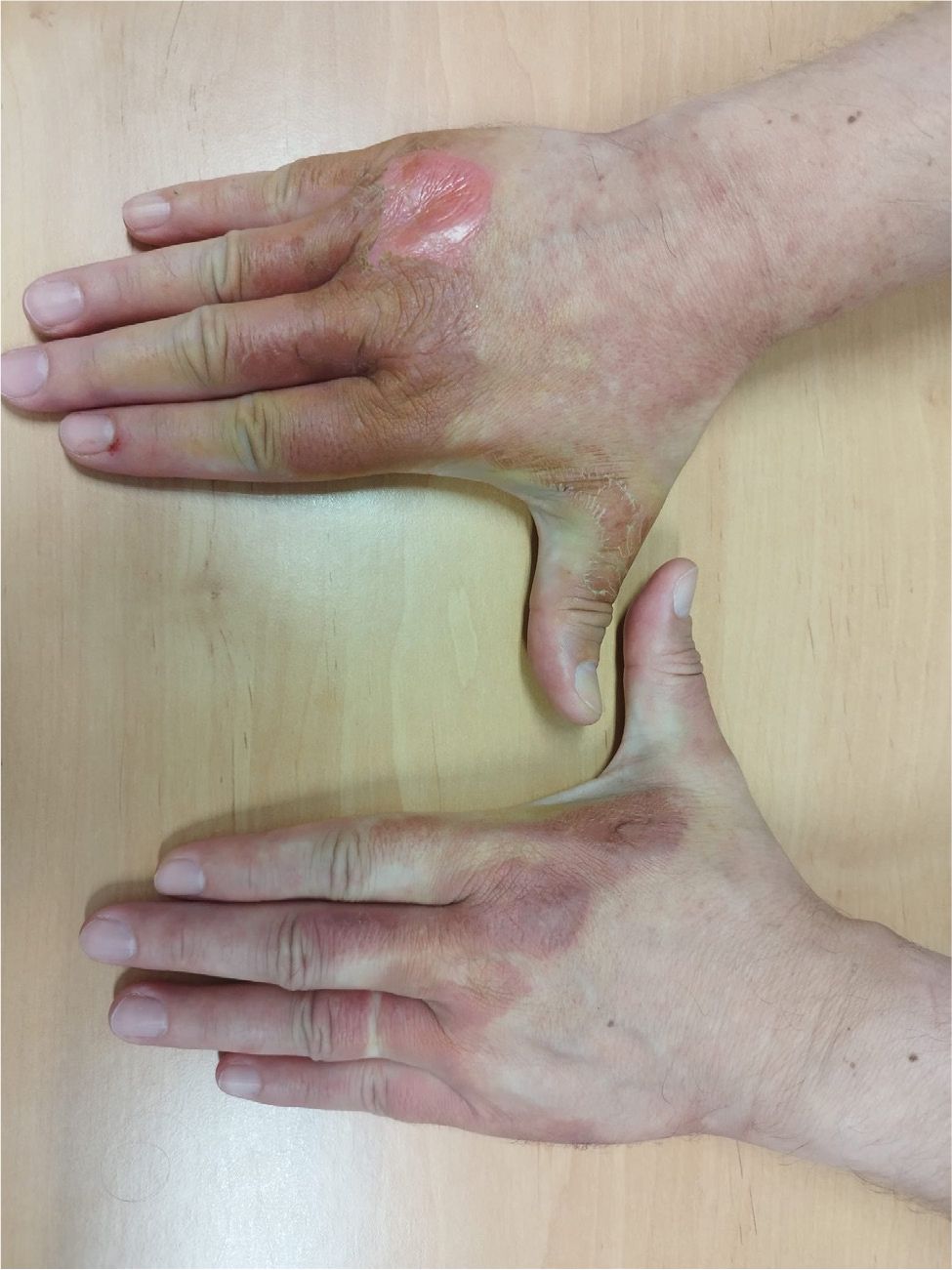
The affected skin was cleansed, and the bullae were deroofed and drained under aseptic technique. The patient was discharged with an oral antihistamine and skincare advice. At one-week follow-up, the acute lesions had completely resolved, leaving post-inflammatory hyperpigmentation (Fig. 2).
(click to enlarge)
Figure 2. Resolution of the acute lesions one week later, with residual post-inflammatory hyperpigmentation.
DISCUSSION
The clinical presentation was most consistent with phytophotodermatitis related to citrus exposure. Citrus fruits contain furocoumarins, which can penetrate the skin and, following activation by UV radiation, and induce a phototoxic reaction. The resulting inflammation may include erythema, vesiculation and bullae, followed by post-inflammatory hyperpigmentation[2,3].
The chronology of exposure is particularly relevant in this case. Lemon exposure occurred on day 1, with sunlight exposure on the same day and the following day. Skin lesions appeared three days after the initial exposure and subsequently worsened. Phototoxic reactions typically develop within 1-3 days following combined exposure to a psoralen-containing plant and UV radiation, making the observed chronology compatible with phytophotodermatitis[2,3]. The bilateral distribution on the exposed portions of the hands and the subsequent hyperpigmentation further support this diagnosis.
However, the simultaneous handling of laurel leaves introduces an additional diagnostic consideration. Laurus nobilis and its derivatives contain sesquiterpene lactones and have been associated with ACD[5]. In the absence of patch testing or photo testing, a contribution from allergic or irritant contact dermatitis cannot be definitively excluded. Importantly, the available clinical information does not establish laurel as a causal agent in this patient. Rather, its simultaneous exposure illustrates the difficulty of assigning causality when multiple potential plant allergens or irritants are involved.
Management relies on identifying and strictly avoiding the offending agents, including wearing protective gloves when handling citrus. Symptomatic acute care includes topical corticosteroids as first-line anti-inflammatory therapy and emollients; while oral antihistamines may reduce pruritus. Residual phototoxic hyperpigmentation can persist for weeks to months, and sun protection of affected areas is recommended[3].