Uncovering an insidious insulinoma with glucagon-like peptide-1 receptor agonist: a case report and review of the literature
1 Department of Internal Medicine, Sengkang General Hospital, Singapore
2 Department of Respiratory Medicine, Sengkang General Hospital, Singapore
3 Department of Endocrinology, Sengkang General Hospital, Singapore
Corresponding author’s e-mail: lim.kai.xiong@singhealth.com.sg
Received: 25/08/2026
Accepted: 05/10/2026
Published: 19/11/2026
Conflicts of Interests: The Authors declare no conflict of interest.
Patient Consent: Written informed consent was obtained from the patient to secure permission for publishing their clinical history.
This article is licensed under a CC Attribution-NonCommercial-NoDerivatives 4.0 License
How to cite this article: Lim KX, Tay SB, Cheong YLB, Wee Z. Uncovering an insidious insulinoma with glucagon-like peptide-1 receptor agonist: a case report and review of the literature. EJCRIM 2026;13:doi:10.12890/2026_007447
ABSTRACT
Introduction: Insulinoma is a rare neuroendocrine tumour that secretes insulin resulting in hypoglycaemia. The initial diagnosis of insulinoma can be challenging in view of the intermittent and non-specific symptoms. Glucagon-like peptide-1 (GLP-1) receptor agonists are increasingly being prescribed for the treatment of diabetes mellitus and obesity. We discuss a case of how a GLP-1 receptor agonist unmasked a previously undiagnosed insulinoma.
Case description: A 48-year-old woman with class III obesity was started on subcutaneous semaglutide, a GLP-1 receptor agonist, for weight management. After the initiation of semaglutide, she started having recurrent symptoms of hypoglycaemia that was initially unevaluated. The symptoms worsened when the patient developed an episode of gastroenteritis, which resulted in her fainting. Further work up of the hypoglycaemia revealed endogenous hyperinsulinaemia, with imaging confirming the diagnosis of an insulinoma. Insulinoma is known to overexpress GLP-1 receptors that bind to GLP-1 receptor agonists. Coupled with the caloric restriction from GLP-1 receptor agonist, exacerbated by acute gastroenteritis, this resulted in the patient presenting with recurrent symptomatic hypoglycaemia.
Conclusion: GLP-1 receptor agonists can unmask previously asymptomatic insidious insulinomas. Since GLP-1 receptor agonist alone should rarely cause hypoglycaemia, a thorough evaluation is required to determine the underlying cause of this patient’s recurrent hypoglycaemia. This is especially important with the increasing usage of GLP-1 receptor agonists.
KEYWORDS
Insulinoma, hypoglycaemia, glucagon-like peptide-1 receptor agonist (GLP-1), multiple endocrine neoplasia type 1 (MEN1)
LEARNING POINTS
- Hypoglycaemia following initiation of glucagon-like peptide-1 (GLP-1) receptor agonists requires a thorough investigation as they rarely cause hypoglycaemia when used as monotherapy.
- Insulinoma can present insidiously and be difficult to diagnose given its intermittent and non-specific symptoms, hence a high index of suspicion is required.
- GLP-1 receptor agonists can unmask previously undiagnosed insulinoma by precipitating symptoms of hypoglycaemia through reduced oral intake and increased insulin secretion due to the overexpressed GLP-1 receptors on insulinoma cells.
INTRODUCTION
Insulinoma is a rare neuroendocrine neoplasm with an incidence of 0.7 to 4 cases per million per year[1]. The initial diagnosis of insulinoma can be challenging and often delayed due to its intermittent symptoms that can be non-specific or mistaken for neurological or psychiatric conditions[1,2].
Glucagon-like peptide-1 (GLP-1) receptor agonists are increasingly used in the treatment of type 2 diabetes mellitus and obesity[3]. Its main adverse effects are gastrointestinal related, including nausea, diarrhoea, constipation, and vomiting[3]. With the increasing usage, there is a need for increased awareness of the side effects and potential complications that may arise from its usage.
Here we report a case of recurrent hypoglycaemia following the initiation of treatment with a GLP-1 receptor agonist. Whilst a GLP-1 receptor agonist on its own should not cause hypoglycaemia, further work-up revealed how the GLP-1 receptor agonist unmasked an underlying insulinoma.
CASE DESCRIPTION
A 48-year-old woman was started on a subcutaneous GLP-1 receptor agonist, semaglutide, to aid in her weight loss as part of her obesity management. Her body mass index was 49.8 kg/m2 and her weight was 134 kg. She had no personal or family history of diabetes or multiple endocrine neoplasia (MEN). Her regular over-the-counter supplements comprised ashwagandha, a multivitamin and a vitamin B complex. There was no history of excessive alcohol consumption.
Over the next two months from the initiation of the GLP-1 receptor agonist, the patient started developing symptoms consistent with hypoglycaemia. These symptoms included hunger, blurred vision, giddiness and tremors. These symptoms usually followed a period of decreased oral intake and would resolve with the consumption of carbohydrates. She did not seek medical attention as she thought these symptoms were expected side effects following initiation of GLP-1 receptor agonist therapy.
The symptoms persisted and remained un-investigated until she developed acute gastroenteritis. She had reduced oral intake, nausea, vomiting and non-bloody non-bilious diarrhoea for 3 days. This coincided with a recent increase in the semaglutide dose to 1.7 mg weekly. The patient fainted at work, and emergency services were called in. Her capillary blood glucose was 1.6 mmol/l when assessed by the paramedics.
The hypoglycaemia was treated with intravenous (IV) 50% dextrose with prompt resolution of the symptoms and a Glasgow Coma Scale score of 15. However, the patient had multiple recurrences of hypoglycaemia when she was monitored inpatient, with her capillary blood glucose readings below 4 mmol/l. The hypoglycaemia episodes were associated with symptoms including tremors, sweating, hunger and palpitations. The symptoms resolved after the hypoglycaemia was corrected with IV 50% dextrose or oral glucose intake. This fulfilled Whipple’s triad. The recurrent hypoglycaemia persisted despite cessation of GLP-1 receptor agonist, resolution of gastroenteritis, improved oral intake, and maintenance intravenous 5% dextrose drip.
A spontaneous blood sample was done during one of the hypoglycaemia episodes demonstrated a serum glucose of 2.0 mmol/l. During this hypoglycaemia episode, there was associated elevated serum insulin of 76.6mIU/L, elevated C-peptide of 11.1 nmol/l and undetectable ketones. As the biochemistry on this spontaneous sample was suggestive of endogenous insulinemia, a supervised 72-hour fast was not conducted.
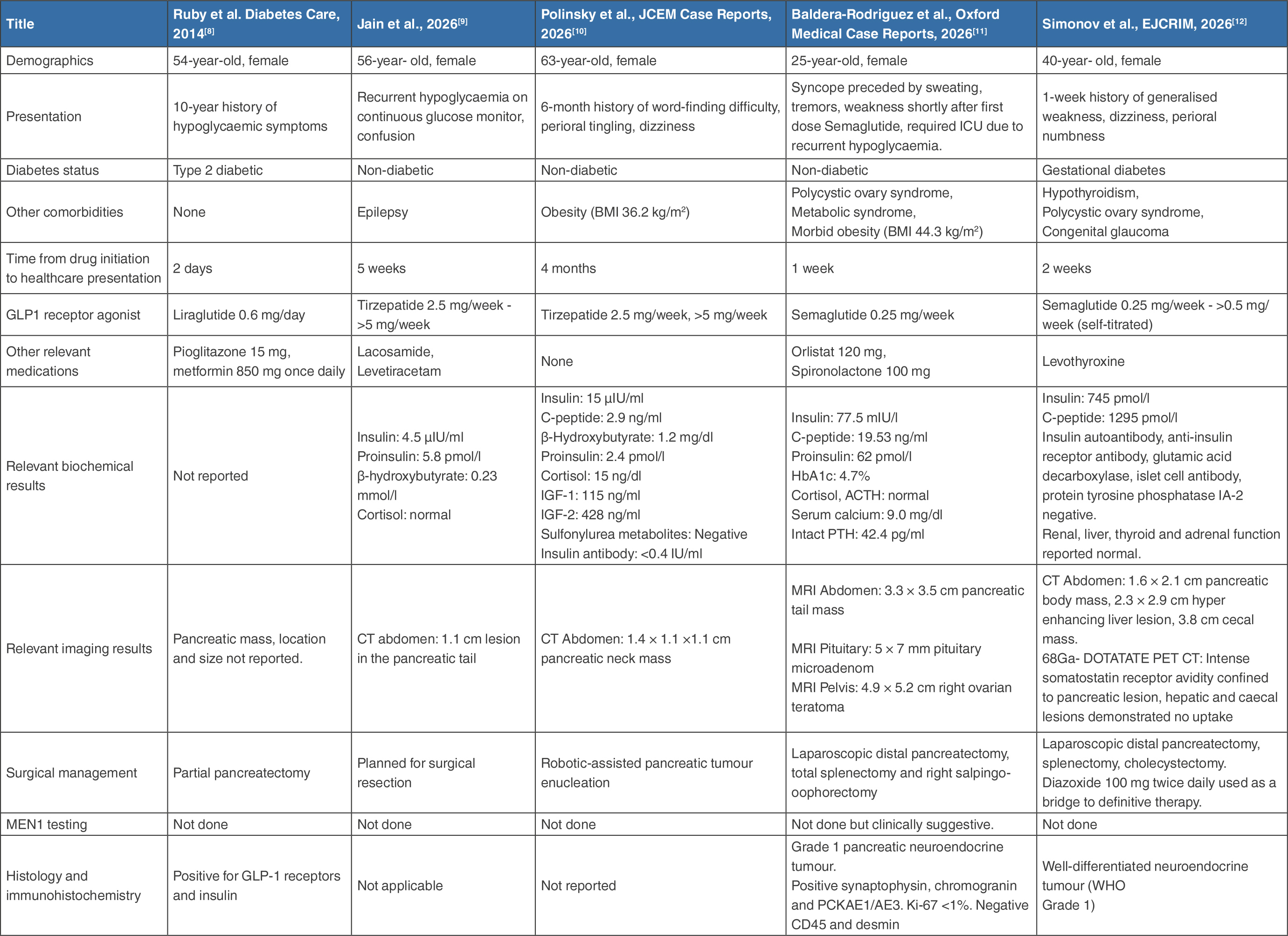
(click to enlarge)
Table 1. Summary of published case reports.
Abbreviations: ICU, intensive care unit; BMI, body mass index; HbA1c, glycated haemoglobin; ACTH, adrenocorticotropic hormone; PTH, parathyroid hormone; IGF, insulin-like growth factor; CT, computed tomography; PET, positron emission tomography; MRI, magnetic resonance imaging; GLP-1, glucagon-like peptide-1; MEN1, multiple endocrine neoplasia type 1; WHO, World Health Organization.
The results of other investigations done, including the short Synacthen test, thyroid function, renal function and hepatic function, were normal. A drug screen was negative, which ruled out ingestion of secretagogues, such as sulfonylureas and meglitinides.
The patient was started on maintenance IV dextrose drip after the hypoglycaemia was corrected with oral glucose and IV 50% dextrose solution. She was advised by a dietitian to take small, frequent, low glycaemic index meals and a bedtime snack. She was also taught to monitor her capillary blood glucose levels, and how to recognise signs of hypoglycaemia and strategies to correct it. Treatment of the hypoglycaemia with pharmacological options, such as diazoxide and octreotide, was not required as she was able to maintain euglycaemia with the above management[4].
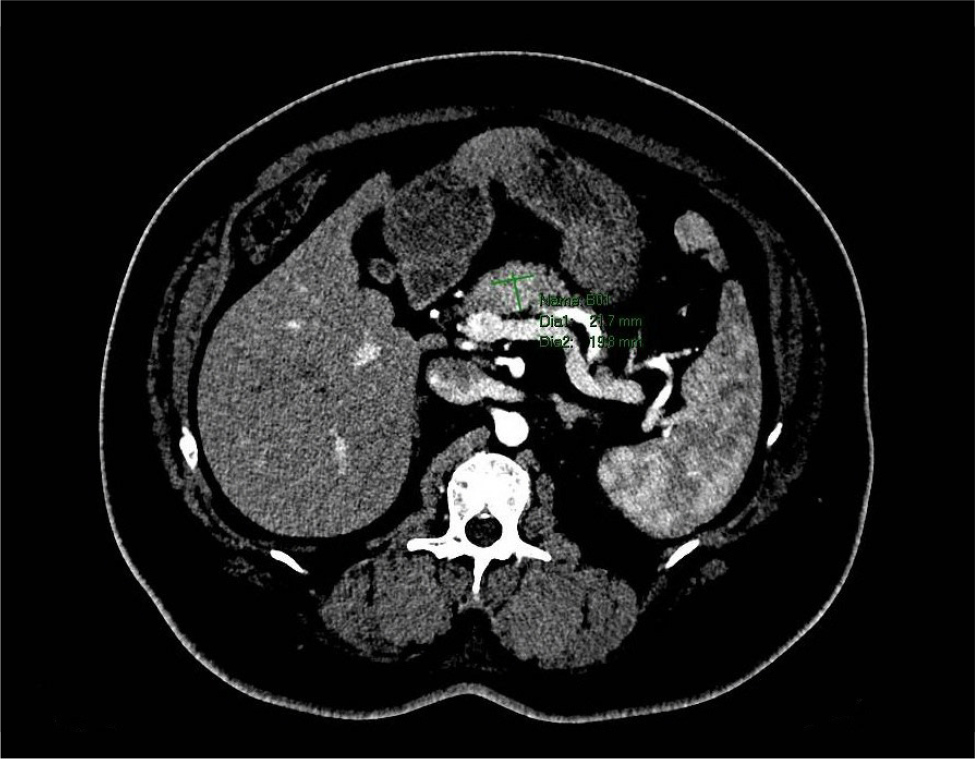
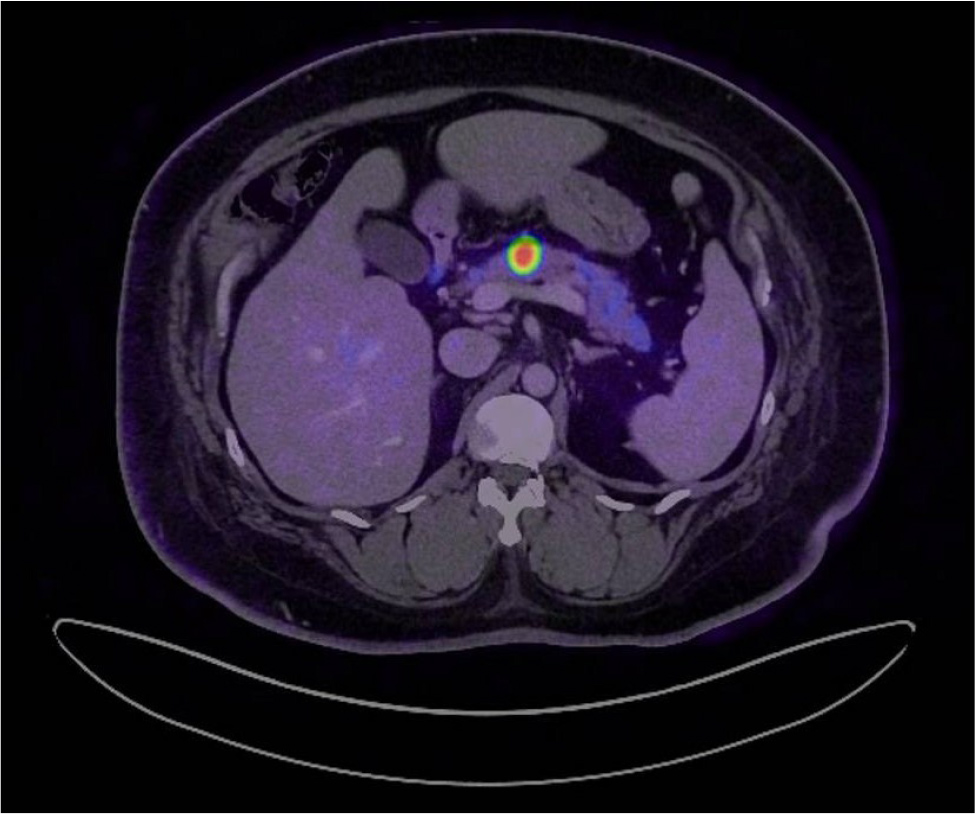
A triphasic computed tomography (CT) scan of the pancreas with liver views showed an ill-defined arterially enhancing lesion measuring 2.2 × 2.0 cm in the proximal pancreatic body (Fig. 1). This lesion is in keeping with a pancreatic neuroendocrine tumour. A subsequent positron emission tomography (PET)-CT scan, using Ga68-NODAGA-Exendin-4, showed a tracer-avid pancreatic body lesion, suspicious of an insulinoma (Fig. 2). As insulinomas can be associated with multiple endocrine neoplasia type 1 (MEN 1)[5], further screening of the parathyroid and prolactin levels was done, and the results were normal.
(click to enlarge)
Figure 1. Triphasic computed tomography imaging of the pancreas showed an ill-defined arterially enhancing lesion measuring 2.2 × 2.0 cm in the proximal pancreatic body.
(click to enlarge)
Figure 2. Positron emission tomography-computed tomography scan showed a tracer-avid pancreatic body lesion, suspicious of an insulinoma.
The patient underwent a laparoscopic spleen-preserving distal pancreatectomy. Histology of the lesion showed a 2.3 cm grade 2 well-differentiated neuroendocrine tumour consistent with an insulinoma given the clinical context. The resection margins and peripancreatic lymph nodes sampled were negative for tumour cells. The patient did not have further hypoglycaemia post operatively. The patient did, however, develop hyperglycaemia post-surgery, that required insulin glargine 38 IU every morning and metformin extended release 1 g every morning.
DISCUSSION
Insulinoma is a rare hormone producing pancreatic neuroendocrine neoplasm derived from beta-cells first described in 1927[6]. Most tumours are sporadic, solitary and confined to the pancreas[1,6]. About 5% to 10% are associated with MEN1 syndrome[1]. Initial diagnosis may be delayed due to intermittent symptoms that can be non-specific or mistaken for neurological or psychiatric conditions[1,2].
GLP-1 receptor agonist is an incretin analogue. It works by promoting glucose-mediated insulin secretion, inhibiting glucagon release, slowing gastric emptying, enhancing satiety and reducing food intake[3]. GLP-1 receptor agonists can be associated with hypoglycaemia when used with other glucose lower agents. However, they rarely cause hypoglycaemia when not used with other antidiabetic medications due to the glucose-dependent insulin release[1,7].
This case illustrates how a GLP-1 receptor agonist can unmask previously asymptomatic insulinomas. This adds to an increasing number of cases being reported with the growing usage of GLP-1 receptor agonists. A review of the existing literature is summarised in Table 1. In a normal individual, a fall in plasma glucose it suppresses insulin secretion and activates a series of counter-regulatory mechanisms that prevents hypoglycaemia[2]. An insulinoma disrupts this balance as it secretes insulin autonomously and largely independent of the serum glucose levels[1]. This risk of hypoglycaemia in patients with insulinoma is buffered by regular carbohydrate intake, which explains why the patient’s symptoms are often associated with poor oral intake or pre-meals. This buffer was, however, disrupted by the initiation of semaglutide, as it reduced appetite and caloric intake and promoted weight loss[3]. The acute gastroenteritis with symptoms of diarrhoea and vomiting further reduced oral intake. This resulted in uncompensated endogenous hyperinsulinism and recurrent symptomatic hypoglycaemia.
The impact of GLP-1 signalling on insulin secretion is of particular interest in this case of hyperinsulinaemia hypoglycaemia as a complementary mechanism exacerbates the recurrent hypoglycaemia[13]. Insulinoma cells have been shown to overexpress GLP-1 receptors, and GLP-1 agonists could augment insulin secretion in hyperinsulinaemic states[8,13]. It is plausible that the potent exogenous GLP-1 receptor agonist directly stimulated insulin release from the insulinoma cells[8]. The radioactive diagnostic tracer, Ga68-NODAGA-Exendin-4, was used in the patient’s PET-CT targeted GLP-1 receptors to locate insulinoma. The tracer avid pancreatic lesion confirmed the expression of the GLP-1 receptors[14]. While the GLP-1 receptor agonist was not the root cause of the hypoglycaemia, its effect on GLP-1 receptor rich insulinoma exposed an insidious tumour that had been present for at least two months[8].
This case highlights the need for increased awareness of the need for further work up of patients who presents with hypoglycaemia following initiation of GLP-1 receptor agonist. As a GLP-1 receptor agonist alone rarely causes hypoglycaemia, there needs to be an increased index of suspicion, especially if there is no other explanation for the hypoglycaemia[8]. This is especially important with the increasing usage of GLP-1 receptor agonists in the treatment of diabetes and obesity. Doing so ensures a rare but curable condition to be identified promptly, allowing early evaluation and treatment before further hypoglycaemic episodes, which can be potentially catastrophic.